Jensen Huang Admits Affair as NVIDIA Board Opens Independent Probe
NVIDIA CEO Jensen Huang publicly acknowledged being unfaithful to his wife on Sunday as the chipmaker's board launched an independent investigation into reports of a foreign intelligence effort targeting him. The inquiry has brought fresh scrutiny to his dealings with AI-chip customers in Asia and the safeguards surrounding one of America's most important technology companies.
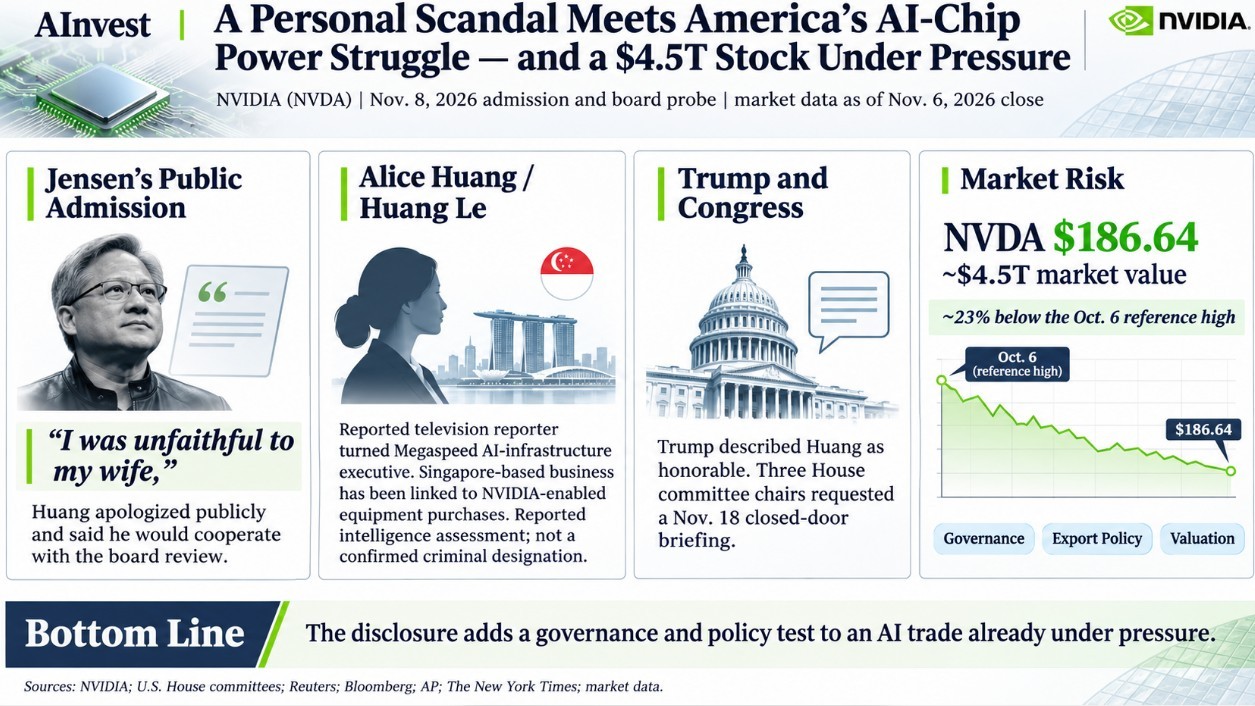
“I was unfaithful to my wife.” Huang also wrote that he had “fallen short of that responsibility” to colleagues, the board, partners and shareholders, while saying he was “fully committed to NVIDIA.”
Alice Huang, also reported as Huang Le, is a Chinese businessperson who previously worked as a television reporter before moving into AI infrastructure. She was reported as an executive at Singapore-based Megaspeed, a company involved in data-center and cloud-computing services and connected to NVIDIA’s regional customer network. The two Huangs are not related.

The commercial connection is why the story reaches beyond celebrity gossip. The New York Times reported that U.S. intelligence officials assessed Alice Huang had been recruited by China’s Ministry of State Security to gather information about Jensen Huang and potentially influence access to advanced American AI chips. The assessment reportedly circulated among senior Trump administration officials in a memo overseen by Secretary of State Marco Rubio. There is no public evidence that Huang was aware of her alleged intelligence ties.
The Times-linked reporting described a Malaysia-related entity purchasing at least $4.8 billion of advanced equipment containing NVIDIA technology between June 2024 and February 2026. The figure refers to equipment bought by a related entity—not direct NVIDIA revenue or a personal purchase by Alice Huang—and helps explain why Megaspeed’s commercial links drew scrutiny.
NVIDIA had previously characterized meetings between Huang and Asian customer executives as ordinary business interactions and said customers received ordinary commercial information rather than classified material. The board’s later action is a separate governance step, not necessarily a reversal of that earlier statement.
The board said a committee of independent directors, assisted by outside counsel, would oversee the inquiry. It said there was “no reason to believe” U.S. national security or NVIDIA secrets had been compromised, while promising to examine all available information.
No public material supplied for this article confirms what information Alice Huang allegedly passed, when any alleged collection began, whether any policy was changed because of it, or whether she remains a Megaspeed executive. No formal public response from Alice Huang was located.
Trump Defends Huang as Congress Raises the Stakes Over China
President Donald Trump offered public support as the national-security dimension of the story moved toward Capitol Hill. Reuters reported that Trump called Huang “an honorable guy,” said he had “not spoken to him about it,” and said Huang had done an “amazing job for our country.” Asked whether Huang should remain CEO, Trump said, “I think so. Oh yeah, sure.”
That matters because Huang is not an ordinary technology chief. NVIDIA’s accelerators sit at the center of the U.S.-China race for artificial-intelligence capacity, while Huang has repeatedly argued that Washington should avoid unnecessarily tight restrictions on chip exports. Trump’s comments may reduce immediate investor anxiety about a forced succession, but they do not stop an independent board review, answer questions about access controls or create an export-control exemption.
The contrast with Congress is direct: the White House offered confidence while Republican committee leaders sought information. Brian Mast of the House Foreign Affairs Committee, John Moolenaar of the House Select Committee on China and Rick Crawford of the House Intelligence Committee sent a November 4 letter requesting a joint closed-door briefing. The public announcement followed on November 5; the lawmakers asked for a response or alternative date by November 11 and proposed November 18 for the briefing.
“Recent reports raise significant national security concerns regarding the PRC’s access to sensitive U.S. technology and information,” the chairmen wrote.
The request focuses on NVIDIA’s safeguards against foreign-adversary espionage, Huang’s interactions with Alice Huang and the risk that the People’s Republic of China could obtain sensitive technology or information. It is a confirmed congressional request, not a subpoena, a finding of wrongdoing or proof that an intelligence operation succeeded. Attendance and any outcome were not established in the supplied record.
The policy channel is larger than the private relationship. A closed-door briefing could lead lawmakers to ask how customer diligence works, who can access technical or strategic information, how overseas cloud partners are monitored and whether export-control enforcement is keeping pace with AI infrastructure sales. Those questions can create friction even if the board finds no compromised secrets.
October 29
The Times first reported the intelligence concern and Alice Huang’s reported connection to Megaspeed.
November 4
Three House committee chairs dated a joint request for a closed-door briefing—four days before Huang’s public apology.
November 5
The House request became public, focusing on security protocols and sensitive technology.
November 8
Huang apologized; NVIDIA announced an independent board investigation; Trump defended him.
November 11 / 18
Response deadline and requested briefing date; attendance and outcome remain unconfirmed.
China has described the reported espionage claims as groundless speculation. NVIDIA’s public board statement did not identify a country and said the investigation would examine all available information. Secretary Rubio declined to comment publicly, describing the matter as an internal corporate issue.
NVIDIA's $4.5 Trillion Valuation Faces a New Test as AI Stocks Sell Off
NVIDIA was already struggling with a sharp AI-chip selloff when Huang issued his public apology and the board announced its investigation. Shares closed Friday at $186.64, about 23% below their October high, leaving the chipmaker valued at roughly $4.5 trillion — behind Apple's nearly $5 trillion.
NVIDIA and Apple Market-Cap Context
The earlier selloff reflected a broader debate about hyperscaler capital spending, data-center financing, credit spreads, borrowing costs, infrastructure returns and semiconductor valuations. The new controversy adds a different variable: whether investors apply a governance and policy premium to a company whose founder remains central to its strategy, Washington relationships and export-policy debate.
The investigation introduces a risk NVIDIA’s recent selloff had not previously priced around: uncertainty over the leadership and political relationships behind its global AI business. No disruption to customer orders or chip shipments has been disclosed. The more immediate threat is to investor confidence, particularly if congressional scrutiny extends to foreign-customer vetting or NVIDIA’s influence over U.S. export policy. AMD and Broadcom have less direct exposure to the governance controversy, although further weakness in NVIDIA could still weigh on semiconductor sentiment and major technology funds.
Could Jensen Huang Be Forced Out? History Offers a Warning
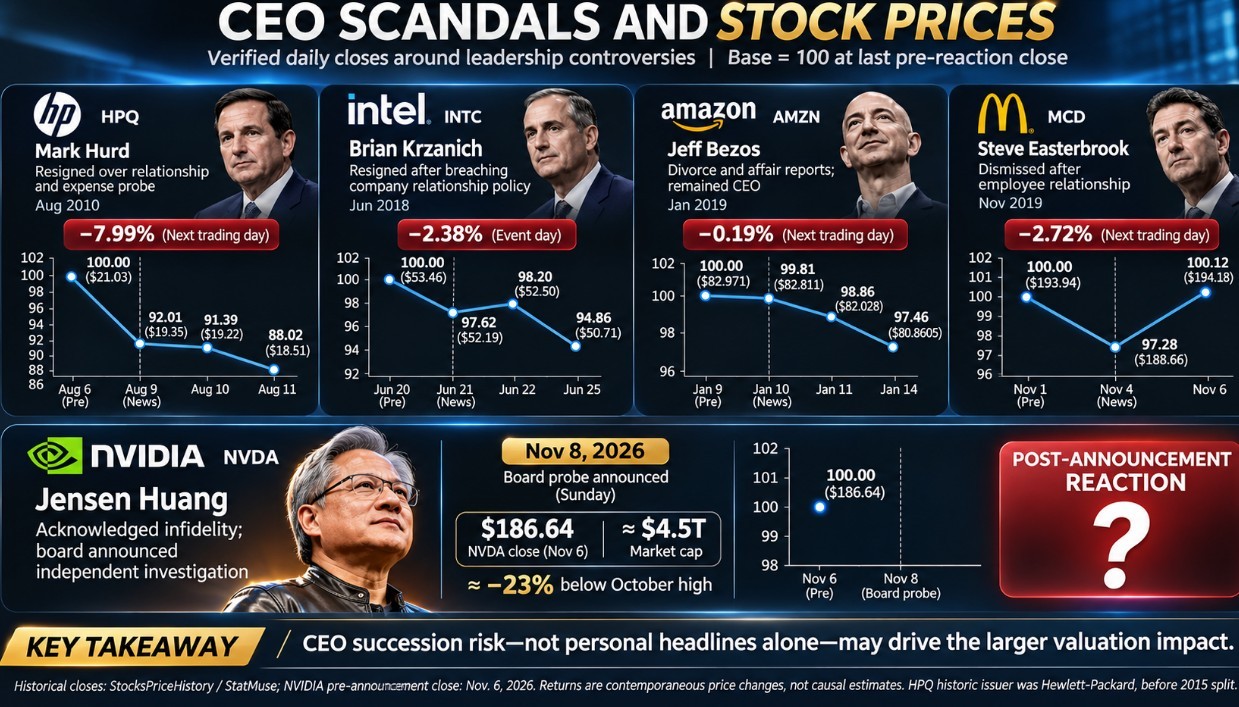
History suggests CEO scandals hurt stocks most when they disrupt leadership. Intel fell 2.4% after Brian Krzanich resigned in 2018, while HP lost roughly 8% following Mark Hurd’s 2010 departure. McDonald’s dropped 2.7% after Steve Easterbrook was dismissed in 2019. Amazon, by contrast, slipped just 0.2% following Jeff Bezos’s divorce announcement, with its founder remaining CEO. A Stanford study of 38 CEO misconduct cases found an average three-day market-adjusted decline of 3.1%, while 58% ultimately resulted in CEO termination. The sample covers different types of misconduct, not just affairs.
For NVIDIA, the real risk is losing Jensen Huang. His leadership is central to its AI strategy, hyperscaler relationships and U.S. chip-export policy discussions. Trump’s backing and the board’s confidence reduce immediate succession concerns, but congressional scrutiny and the independent investigation could complicate his position if material findings emerge. At a $4.5 trillion valuation, an unexpected leadership change could matter far more than the scandal itself.
| Exposure | What changes | Key Market Risk |
|---|---|---|
| NVDA | Leadership, customer diligence, export-policy scrutiny and valuation risk premium. | Leadership scrutiny, customer-vetting questions or a policy-driven valuation discount. |
| AMD | Potential relative attention as an AI-chip alternative, plus shared export and sector risk. | Sector-wide AI spending and export-policy risk despite less direct governance exposure. |
| AVGO | Sentiment spillover through custom AI silicon and networking demand. | AI infrastructure and semiconductor sentiment could weaken alongside NVIDIA. |
| QQQ / SOXX | Concentration and risk-appetite sensitivity across large technology and semiconductor holdings. | Concentration in large technology and semiconductor names leaves funds exposed to broader risk aversion. |
Dan Ives called the episode a “black eye moment” and warned it could become an “overhang.” For investors, the key question is whether scrutiny stays reputational or starts to affect confidence in NVIDIA’s leadership, customer controls or access to U.S. policy discussions.
Three paths for the risk premium
| Path | Trigger | Market read |
|---|---|---|
| Contained shock | Board finds no material security or governance failure. | Attention returns to AI demand, earnings and infrastructure returns. |
| Prolonged overhang | Congressional questions and the review remain open without a decisive finding. | NVIDIA carries a modest governance and policy discount while uncertainty persists. |
| Material escalation | Evidence of security damage, regulatory action or leadership change emerges. | Both operating assumptions and the valuation framework require reassessment. |
NVIDIA's November 17 earnings report will put the AI growth story back under scrutiny, followed by the congressional briefing requested for November 18. Strong results could revive confidence in the chipmaker after its steep selloff, while any expansion of the investigation into customer relationships, security controls or export policy would introduce risks that earnings alone cannot resolve.
Risk Disclosure
For information only — not investment advice. Stock investments carry risk, including loss of principal. Data current through November 9, 2026; re-verify before acting.