
Nvidia's $500B AI Financing Consortium: The Deal That Redefines a Chipmaker
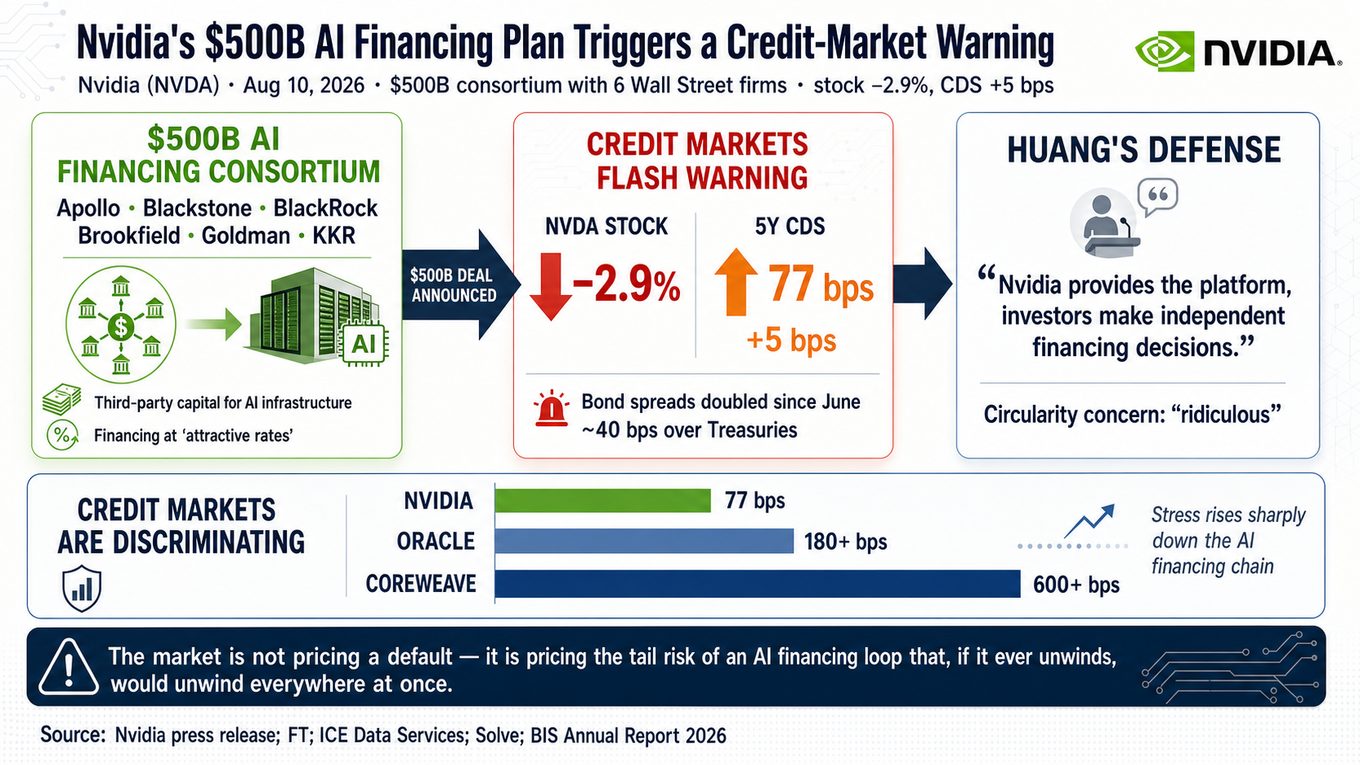
On August 10, 2026, Nvidia announced it had signed memorandums of understanding with six of the world's largest financial institutions — Apollo Global Management, Blackstone, BlackRock's Global Infrastructure Partners, Brookfield Asset Management, Goldman Sachs, and KKR — to "mobilise over $500 billion of third-party capital for the build-out of AI infrastructure over time."
The deal structure is novel. Rather than Nvidia taking on debt directly, the six firms will create dedicated pools of capital — independent compute financing platforms — that lend to Nvidia's customers "at attractive rates." Nvidia provides the ecosystem, the technology platform, and the customer relationships; the financial partners provide the capital and perform independent underwriting on each project. Final agreements are still being negotiated.
"We began by building chips. Today, we are helping create a new class of productive, investable infrastructure: AI factories." — Jensen Huang, Nvidia CEO

Blackstone President Jon Gray underscored the institutional conviction: "We continue to be enormous investors globally across the Nvidia ecosystem, and this announcement further underscores our confidence in their platform and the future of AI infrastructure."
This is not a financing announcement — it is a category redefinition. Nvidia is no longer just a chip supplier; it is becoming the capital-mobilization layer of the AI economy, creating a new asset class: AI compute as investable infrastructure.

Market Verdict: Credit Markets Flash Warning as Equity Investors Sell the News
The market's reaction was swift and negative. Nvidia shares fell as much as 3.2% intraday before closing at $217.55, down 2.86% — erasing roughly $130 billion in market value. The stock had rallied 5.6% in the prior five trading days, suggesting some of the selling was "buy the rumor, sell the news" dynamics. After-hours trading saw a modest 0.91% rebound to $219.53.
But the real action was in credit markets. Nvidia's 5-year credit default swap jumped to 77.215 basis points, up approximately 5.3 basis points on the day — the largest single-day move in two weeks. This follows the all-time record of 82 basis points set on July 27, when reports emerged of Nvidia's $250 billion OpenAI data-center guarantee. The CDS contract only began actively trading in November 2025, making these levels unprecedented in the instrument's short history.
The bond market is telling a similar story. Since June, bond investors have doubled the incremental yield they demand to lend to Nvidia — to roughly 0.40 percentage points over comparable U.S. Treasury bonds, according to pricing service Solve. For a company with $48.6 billion in annual free cash flow and a $3.4 trillion market cap, a 40-basis-point spread is hardly distressed — but the doubling in two months signals that credit investors are repricing the tail risk of Nvidia's growing web of contingent liabilities.
Nvidia Bond Spread Over U.S. Treasuries

Jensen Huang Fires Back: "Nvidia Provides the Platform, Investors Make Independent Decisions"
Facing the market's skepticism, Jensen Huang took to X to mount a five-layer defense of the financing model — calling the circularity concern "ridiculous."
Demand Breadth
Frontier AI labs, AI-native startups, enterprise customers, cloud service providers, and nations building AI services — the demand is real, not a single-customer story.
Independent Underwriting
Each capital partner underwrites every project independently, evaluating customer creditworthiness, demand profiles, utilization rates, cash flow projections, and residual value. "Nvidia provides the platform, investors make independent financing decisions."
Multi-Tenant Flexibility
An AI factory can serve multiple customers and multiple workload types simultaneously. If one customer's demand changes, the factory can be repurposed for another customer, cloud provider, or operator — protecting residual value.
GPU Longevity
The A100, launched in 2020 on the Ampere architecture, is still productive after six years — potentially extending to a decade. Rental prices for H100 and Blackwell GPUs continue to rise, undercutting the rapid-obsolescence thesis.
New Asset Class
The industry has moved from "enterprises buying chips project by project" to "AI factories as productive infrastructure that can be financed" — with replicable platforms, long-term institutional capital, and a diversified customer base.
Huang's Five Arguments Against Circular Financing
- Demand Breadth — frontier labs, startups, enterprises, clouds, nations
- Independent Underwriting — each partner evaluates every project independently
- Multi-Tenant Flexibility — factories repurposable across customers
- GPU Longevity — A100 (2020) still productive, H100/Blackwell rental prices rising
- New Asset Class — AI compute as investable infrastructure
The CDS Divergence: Why Oracle at 180 bps and CoreWeave at 600 bps Matter More Than Nvidia at 77
If the CDS market were in a blind panic about AI financing, every name in the sector would be widening in lockstep. That is not what is happening.
Since late 2025, credit default swap spreads have widened across major cloud and AI infrastructure providers — but the divergence is stark. Microsoft, Amazon, Alphabet, and Meta all sit in the 45–80 basis point range, reflecting investment-grade balance sheets, diversified revenue streams, and manageable leverage. These are the "too-big-to-fail" names of the AI buildout.
Oracle, at 180-plus basis points, tells a different story. Higher leverage, weaker free cash flow relative to its capex commitments, and a more concentrated cloud business put it in a riskier tier. CoreWeave, at 600-plus basis points, is in a category of its own — a pure-play AI cloud provider with heavy debt financing and customer concentration risk. A 600-bps CDS spread implies a non-trivial probability of default.
5-Year CDS Spreads — AI Infrastructure Players Compared

Nvidia at 77 basis points sits closer to the mega-cap cloud group than to Oracle. For a company with $48.6 billion in free cash flow, a net cash position, and the world's most sought-after technology product, 77 bps is not a default signal — it is a tail-risk signal. The CDS market is pricing the possibility that Nvidia's contingent liabilities could, in an extreme stress scenario, exceed its balance-sheet capacity. That is not a near-term concern — but it is a legitimate tail risk.
| Company | CDS (bps) | Leverage | FCF Profile | Credit Rating |
|---|---|---|---|---|
| CoreWeave | 600+ | High | Negative/Thin | Non-IG |
| Oracle | 180+ | Elevated | Constrained by Capex | BBB-/BB+ |
| Nvidia | 77 | Low/Net Cash | $48.6B FCF | A+ |
| Alphabet | ~65 | Low | Recently Negative | AA |
| Amazon | ~55 | Moderate | Strong | AA |
| Microsoft | ~50 | Low | Strong | AAA |
| Meta | ~48 | Low | Strong | AA- |
The Bank for International Settlements flagged this dynamic in its June 2026 Annual Report, warning that the "opacity of AI financing" amplifies financial vulnerabilities. The BIS identified circular financing — where suppliers provide capital to customers who then buy from suppliers — as the most prominent risk. If AI investment returns disappoint, the withdrawal of financing could be sudden and correlated, creating a "financial accelerator" effect in reverse.
The $1.6 Trillion Mosaic: Nvidia's Total AI Financing Footprint
The $500 billion consortium deal is the headline — but it is only one piece of a much larger financing mosaic. When viewed in aggregate, Nvidia's total AI infrastructure financing commitments approach $1.6 trillion.
In late July, The Wall Street Journal reported that Nvidia was in talks to provide a roughly $250 billion backstop for OpenAI's lease on a 10-gigawatt data center project in Ohio, targeted for 2028. Separately, Bloomberg reported that Nvidia was discussing $350 billion in financing for OpenAI's chip purchases. Earlier, Nvidia and SK Hynix signed a letter of intent for a long-term strategic cooperation totaling over $500 billion — spanning memory chip supply, manufacturing capacity, and joint R&D. Nvidia had also previously announced approximately $540 billion in other AI infrastructure deals.
The aggregate picture is not a single deal — it is the emergence of a systematic AI infrastructure financing layer, with Nvidia at the center as the platform orchestrator. For the six Wall Street firms, this is a structural opportunity: long-duration, contracted cash flows from the fastest-growing segment of the tech economy, at a scale that rivals the infrastructure financing booms of telecom, energy, and real estate in prior decades.
| Project | Amount | Status |
|---|---|---|
| $500B Consortium (6 firms) | $500B | Announced (MOU) |
| OpenAI Data Center Guarantee | $250B | In Discussion |
| OpenAI Chip Purchase Financing | $350B | In Discussion |
| SK Hynix Strategic Cooperation | $500B | MOU Signed |
| Prior Announced Deals | $540B | Announced |
The AI Factory Thesis: Can GPU Clusters Become the Next Commercial Real Estate?
At the core of Huang's rebuttal is an economic thesis: GPU clusters are not depreciating IT equipment — they are productive infrastructure assets, analogous to commercial real estate. If this thesis holds, AI infrastructure can be financed at infrastructure-like terms: longer tenors, lower rates, and lower risk premiums. If it does not, the financing edifice rests on a weak foundation.
Customer A / B / C / N
Multiple tenants rent compute capacity simultaneously
AI Factory (GPU Cluster)
Multi-tenant, multi-workload GPU infrastructure
Compute Revenue
Rental income from diverse customer base
Debt Service + Residual Value
If one customer exits, factory reallocates to others
The bull case rests on three pillars: multi-tenancy reducing single-customer concentration risk; GPU residual value supported by rising H100/Blackwell rental prices and the A100's six-year productive life; and secular AI compute demand growth creating a structural shortage.
The bear case also has evidence. Amazon recently shortened server depreciation periods, implicitly acknowledging that technology obsolescence can outpace accounting assumptions. GPU generations are arriving faster than ever — Blackwell followed Hopper in under two years, and Rubin is expected in 2027. If each new generation makes the previous one economically obsolete faster than the loan term, the "infrastructure asset" framing collapses.
Key Verification Signals
- GPU rental price trends — if H100/Blackwell rates decline, the residual-value thesis weakens
- Nvidia CDS trajectory — stabilization below 80 bps would signal market acceptance; another spike above 82 would flag escalation
- Fed rate path — higher rates would amplify stress on leveraged AI infrastructure players
- OpenAI deal finalization — terms of the $250B guarantee will reveal the true extent of Nvidia's contingent liabilities
Risk Disclosure
This content is for informational purposes only and does not constitute investment advice, a recommendation, or an offer to buy or sell any security. The views expressed are based on publicly available information as of August 11, 2026, and are subject to change without notice. Past performance is not indicative of future results. Investing involves risk, including the possible loss of principal. Readers should conduct their own due diligence and consult with a qualified financial advisor before making any investment decisions. Data sourced from Nvidia press releases, Financial Times, Wall Street Journal, Bloomberg, ICE Data Services, Solve, Bank for International Settlements, S&P, Moody's, and company filings.