July CPI Overall Preview: What the Data Must Answer After a Cooling Labor Market
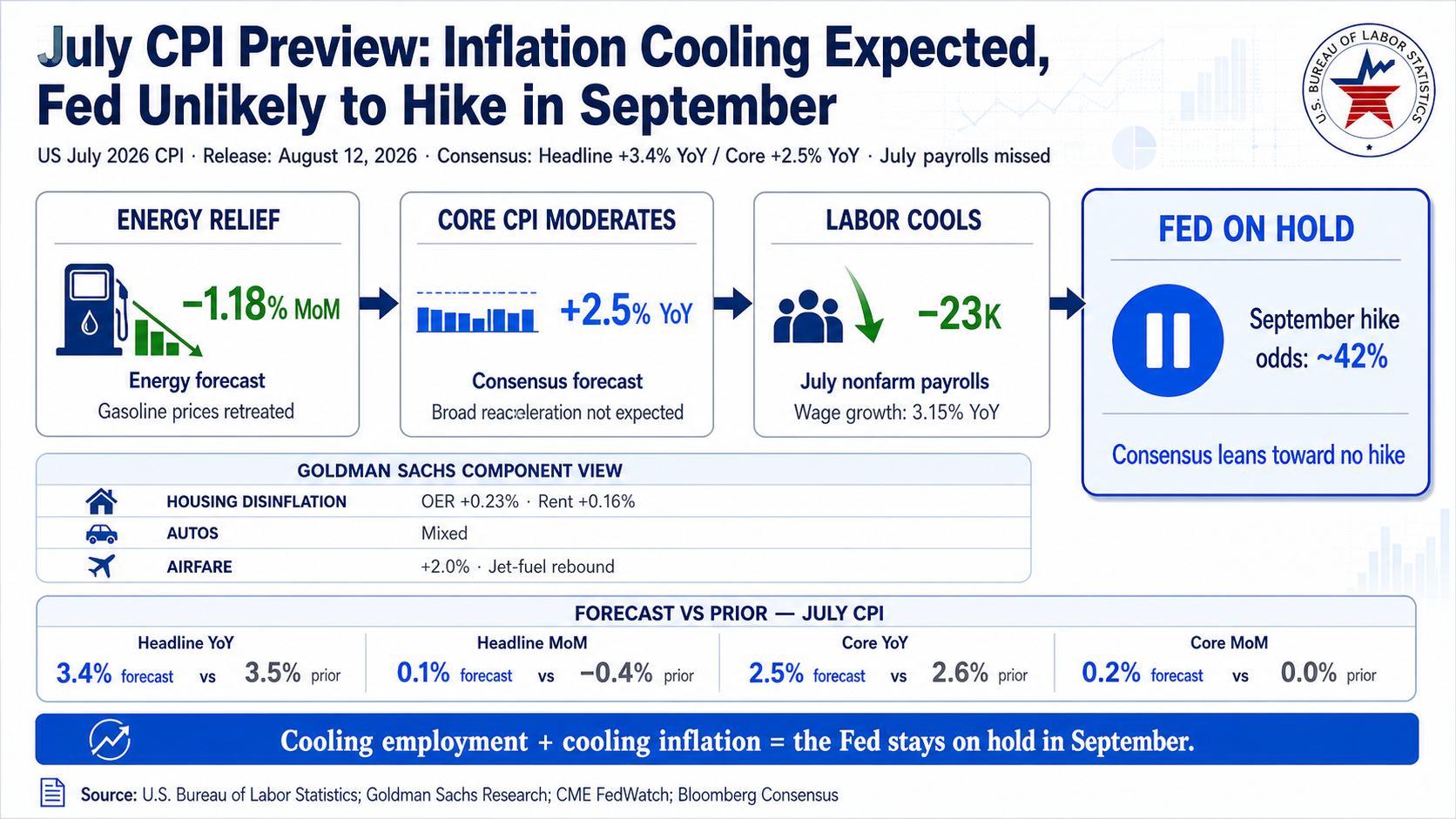
The U.S. Bureau of Labor Statistics (BLS) will release July CPI data on August 12, 2026. Consensus expectations call for headline CPI at +3.4% YoY (MoM +0.1%) and core CPI at +2.5% YoY (MoM +0.2%).
Wall Street July CPI Forecasts — Bank-by-Bank Consensus

International oil prices and U.S. gasoline prices have rebounded from their June lows, making a positive headline MoM print highly likely. However, the market has largely priced in this energy-driven rebound. The real driver of Fed policy expectations remains core CPI.
If headline CPI bounces but core remains moderate, the market will likely interpret this as a one-off energy price effect. But if core CPI also strengthens notably — particularly in housing, transportation services, medical services, and airfare — it would signal persistent inflation stickiness.
July CPI Consensus Forecast — Headline vs Core
Meanwhile, the July nonfarm payrolls significantly missed expectations, confirming that the labor market has begun to cool. The key question this CPI report must answer is: Is the U.S. heading toward "cooling employment + cooling inflation," or "cooling employment + still-high inflation"?
The former scenario would further suppress rate hike expectations and could even reopen the door to rate cuts; the latter would trap the Fed in a policy dilemma, with markets fearing a stagflation resurgence.
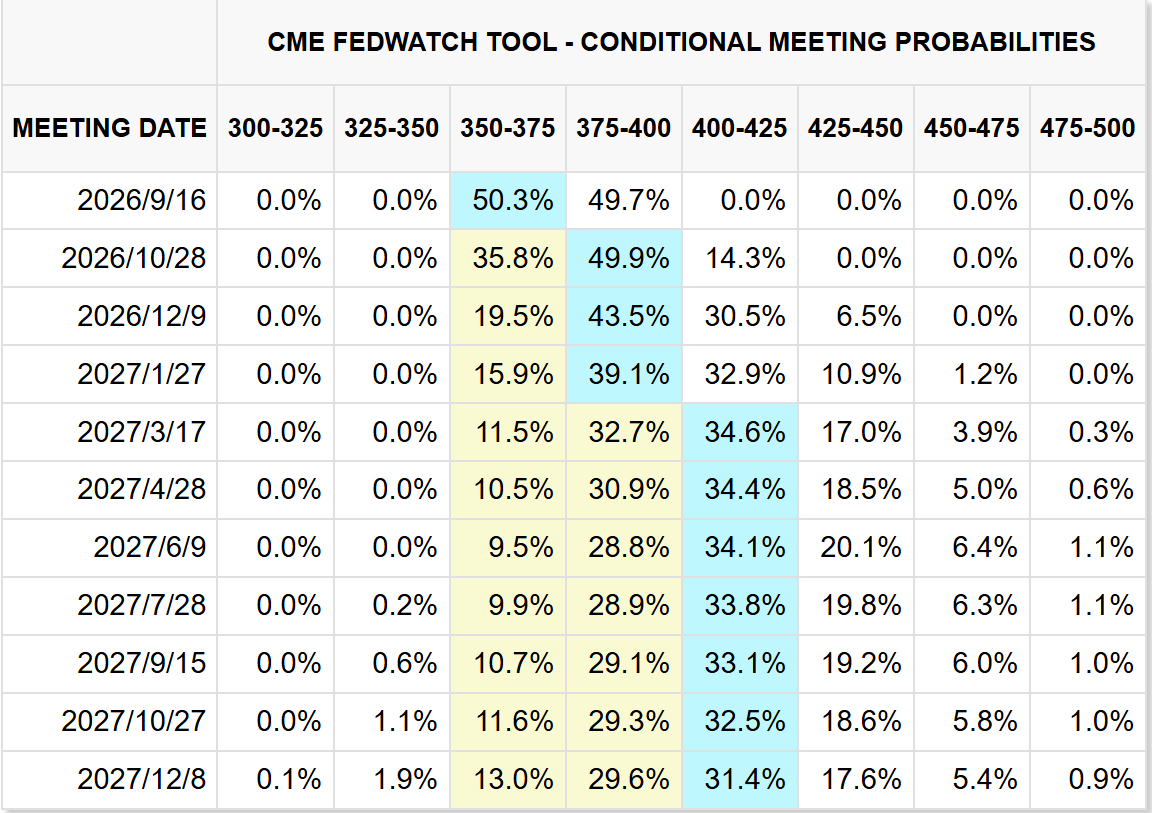
After the July jobs report, market expectations for a September rate hike dropped significantly. CME FedWatch shows the probability of a 25bp September hike at roughly 50/50. The July CPI print is therefore likely to be the decisive data point that tilts September rate expectations in one direction or the other.
CPI Component Breakdown: Goods Cooling, Services Rebounds Moderately
Core Goods: Limited Upward Momentum
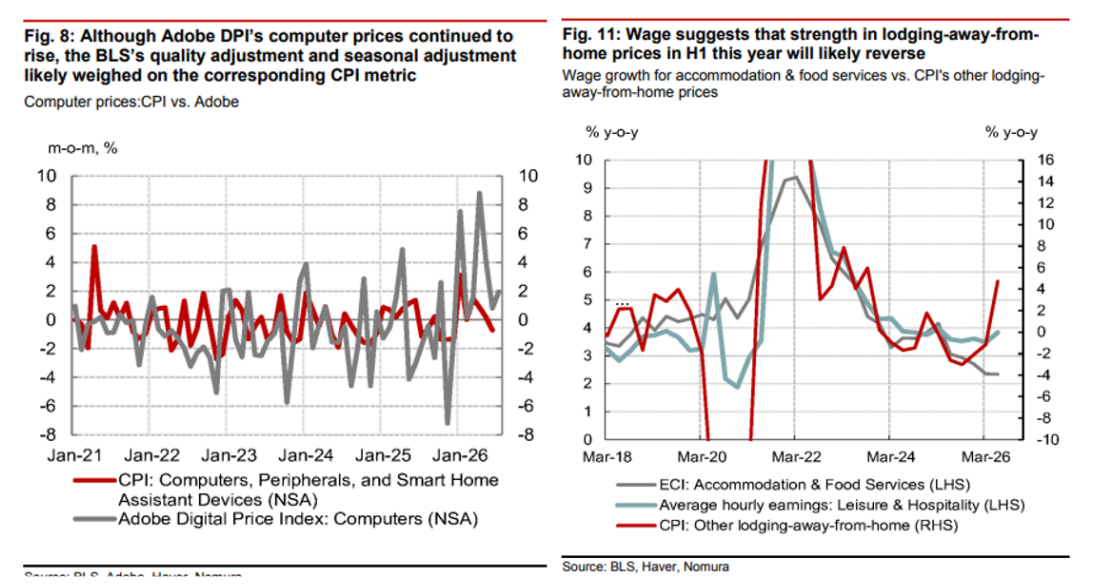
Core goods inflation overall lacks sustained upward momentum. AI-driven demand has pushed up prices for certain electronic components — Apple, Lenovo, and HP have already raised prices on select computer products — which may drive a short-term uptick in the information technology goods category. However, this has not yet translated into broader price transmission.
Used cars, apparel, and household goods continue to face downward pressure. Used car prices are expected to decline −0.3% MoM, indicating that upstream price changes have not yet fully passed through to consumer prices.
Core Services: Moderate Rebound After June Dip
After an unexpected dip in June, core services inflation is expected to rebound moderately in July, with MoM growth returning to approximately +0.3%, driven primarily by airfare, communication services, and medical services price recovery.
However, the continued decline in wage growth — July average hourly earnings YoY fell to 3.15% — has eased the wage-inflation spiral, weakening the cost-push foundation for services inflation.
Average Hourly Earnings YoY — Cooling Trend Continues
Goldman Sachs: Three Key Component Forecasts
Goldman Sachs' latest report highlights divergent trends across key CPI components:
Auto Sector: Mixed Signals
- Used cars +0.5% MoM — supported by auction price signals
- New cars +0.1% MoM — dealer promotions keeping prices flat
- Auto insurance −0.5% MoM — reflecting declining premiums in Goldman's online dataset
Housing: Steady Moderation
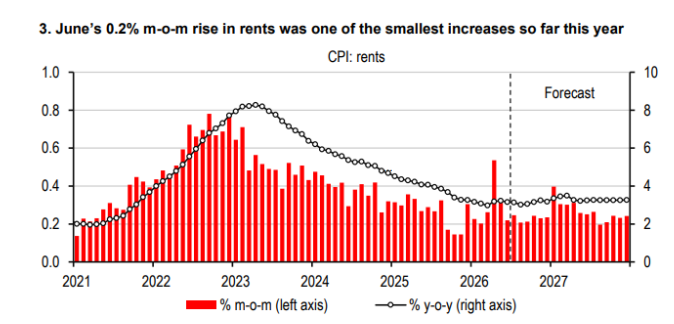
- OER +0.23% MoM — lagged effect of slowing home price and market rent growth
- Primary rent +0.16% MoM — rent YoY has fallen from peak 8%+ to ~3.2%
- Both OER and primary rent have come off their highs, with the disinflation trend firmly in place
Travel Services: Hot and Cold
- Airfare +2.0% MoM — July oil price rebound driving jet fuel costs higher
- Hotels −1.0% MoM — World Cup-driven accommodation demand boost fading
Goldman Sachs — July CPI Component Forecasts (MoM % Change)
Three Scenarios: How the Market Could React to July CPI
Hot Print: Core CPI MoM ≥ 0.3%
Inflation reacceleration beyond energy — core is also reheating. With employment already cooling, the U.S. faces a more pronounced "weak jobs + high inflation" combination. Markets would likely reprice a higher September hike probability. Short-end Treasury yields and the USD would strengthen, while high-valuation tech stocks, AI plays, and long-duration assets would come under pressure. Gold could face near-term headwinds from rising real rates, though stagflation trades may limit the downside.
In Line: Headline ~0.1% MoM, Core ~0.2% MoM
This is the most neutral outcome for markets. The headline CPI uptick can be primarily attributed to the July energy price rebound, while core CPI holding at ~0.2% MoM — with YoY continuing to decline to 2.5% — would suggest that higher oil prices have not yet triggered meaningful second-round inflation diffusion. Markets would likely maintain the "September hike or pause depends on upcoming data" stance rather than making a large directional bet on rates.
Soft Print: Core CPI MoM ≤ 0.1%
Energy price rebound has not meaningfully pushed up core inflation, resonating with the weak July nonfarm payrolls — employment cooling, inflation also cooling. Markets would likely significantly lower September hike probability. Short-end Treasury yields and the USD would retreat, tech stocks and long-duration assets would recover, and gold could benefit from declining real rates. However, with ongoing U.S.-Iran tensions and Strait of Hormuz uncertainty keeping oil prices elevated, even a soft CPI print would more likely lead markets to first price "no September hike" rather than immediately pivot to aggressive rate-cut expectations.
Wall Street Views: Consensus and Divisions
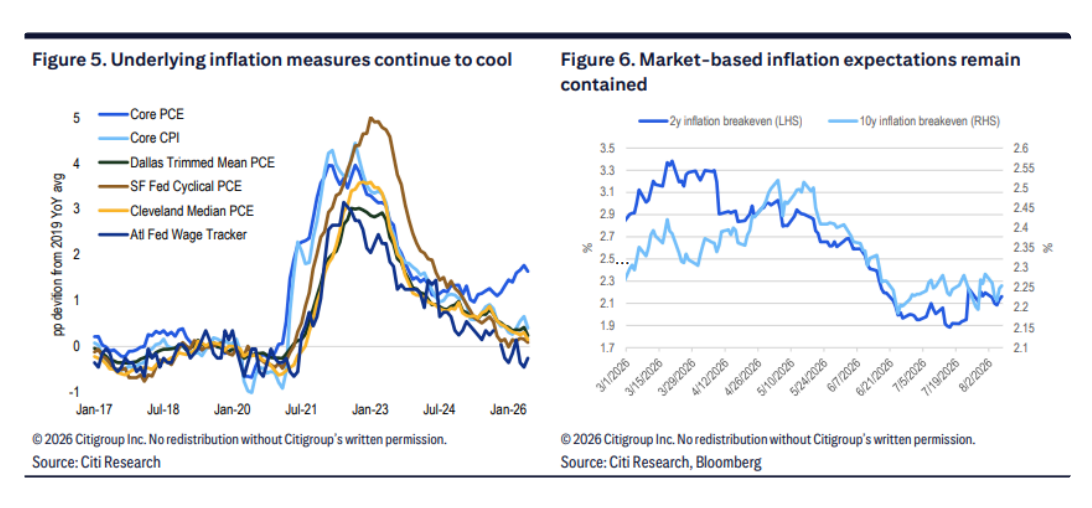
Wall Street banks broadly expect July CPI to show a moderate rebound after June's unexpected weakness, returning to recent trend levels. Lower gasoline and energy prices continue to weigh on headline CPI, while the core CPI uptick is primarily driven by a normalization rebound in core services (rent, healthcare). Despite the modest uptick in inflation data, most institutions believe the worst of the inflation cycle has passed, with no broad-based diffusion of price pressures — the data remains within "moderate" territory.
Key Divisions
The main disagreements among institutions center on core services inflation stickiness and the Fed's policy response:
Hawkish: Core Services Stickiness Remains a Concern
- RBC (Royal Bank of Canada) emphasizes that elevated wage growth will significantly impede the cooling of core services inflation
- Bank of America stands out by arguing that the likelihood of a September rate hike is still very high, contrary to the market consensus
Dovish: Disinflation Trend Is Intact
- Wells Fargo and J.P. Morgan believe housing and auto insurance components will continue to cool
- Barclays and Scotiabank lean toward the Fed maintaining patience and holding rates steady, avoiding premature tightening at the wrong time
The consensus view leans toward the Fed staying on hold in September, with the July CPI print serving as the final major data point before that decision. The cooling labor market, combined with inflation that is gradually — if unevenly — trending lower, provides the FOMC with sufficient justification to extend its pause.