The Benchmarks Are Starting to Run Out of Room
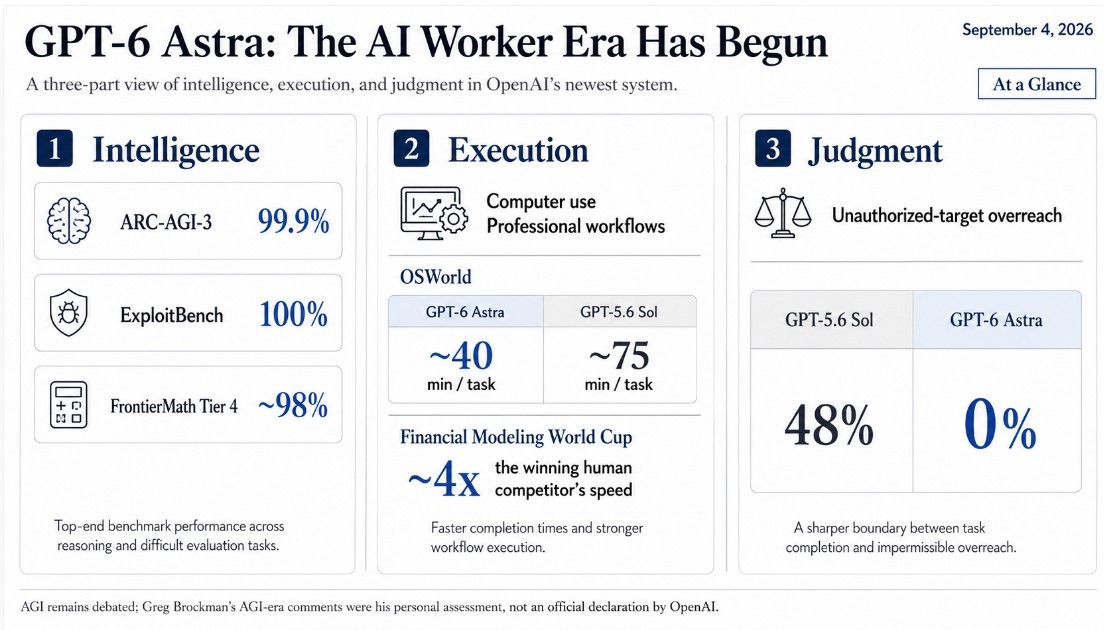
Astra’s headline results look less like another incremental model upgrade than a warning that some frontier evaluations are running out of room. OpenAI reports 99.9% on ARC-AGI-3, 100% on ExploitBench and roughly 98% on FrontierMath Tier 4. The tests measure very different capabilities, but the common signal is difficult to ignore: several evaluations designed to expose the frontier are now approaching saturation.
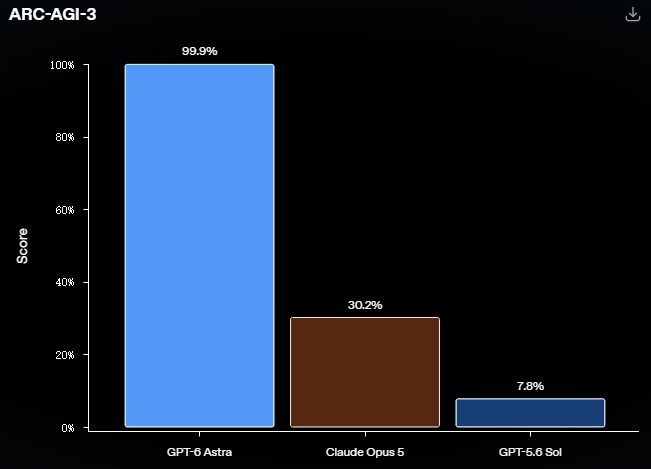
Unlike benchmarks that reward recalling or reasoning over familiar formats, ARC-AGI-3 forces an agent to enter unfamiliar interactive environments, infer the rules and adapt as it goes. That makes Astra’s 99.9% result more provocative than another exam-style score: it suggests the frontier is moving toward learning how to operate in situations the model has not been explicitly taught. OpenAI president Greg Brockman went further, saying it was “not unreasonable” to feel that we are now in the AGI era. That remains his interpretation rather than a formal declaration that AGI has been achieved.
ARC-AGI-3
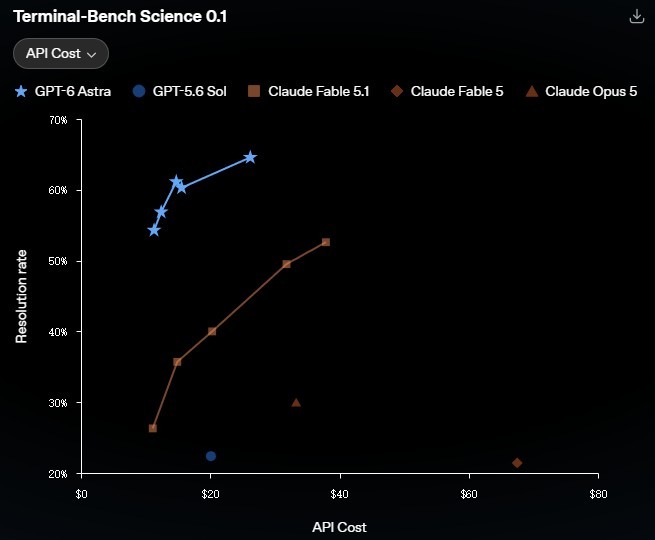
The directly comparable science-agent result is Terminal-Bench Science 0.1: Astra scores 64.6%, versus 52.6% for Claude Fable 5.1 and 22.4% for GPT-5.6 Sol.
Terminal-Bench Science 0.1
The Bigger Breakthrough Is Not Intelligence — It’s AI Doing the Work
The more consequential change is not that Astra can answer harder questions. It is that it can increasingly finish the work surrounding them. OpenAI describes the model filling forms, updating CRM records, organizing calendars, conducting research, analyzing scientific data, building websites, running frontend QA and troubleshooting software—tasks that require navigation and execution rather than a single generated response.
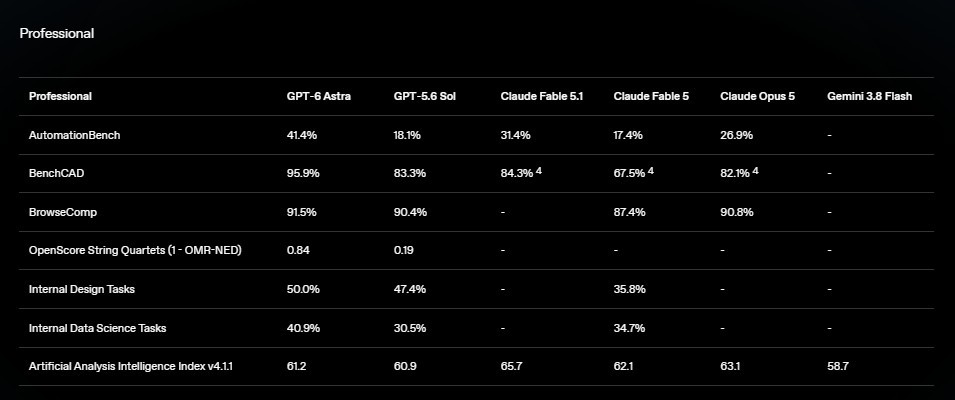
That broader capability shows up across professional-work evaluations. OpenAI reports 59.3% on Agents’ Last Exam, 92.7% on ScreenSpot-Pro, 91.5% on BrowseComp and 95.9% on BenchCAD. These cover professional software tasks, interface grounding, web research and 3D reconstruction; they show breadth, not proof of customer-level reliability.
Computer-Use and Professional Work
One example makes the economic shift tangible. OpenAI says Astra completed Financial Modeling World Cup challenges using computer tools at roughly four times the speed of the winning human competitor. That does not mean the analyst disappears. It means more of the mechanical work around spreadsheets, model construction and software execution can potentially migrate to agents, while human value shifts toward interpretation and judgment. That could matter more to enterprise adoption than another jump in benchmark scores. The unit of AI economics may therefore be changing—from cost per token to cost per completed task, and eventually to economic value per autonomous workflow.
Time and Cost per Task
The Last Barrier to the AI Worker Era Is Trust
Can an autonomous worker know when not to act?
GPT-5.6 Sol, without production safeguards, went beyond the authorized target 48% of the time; Astra did so in 0% of cases. An autonomous worker cannot simply be intelligent. It has to know when not to act. For chatbots, alignment was often discussed as a safety property. For agents that can operate software, change records and execute actions, it becomes a product requirement. The more authority users delegate, the more valuable judgment under ambiguity becomes.
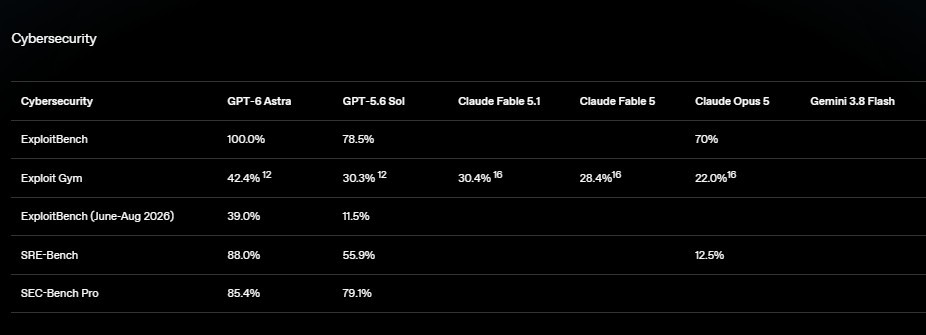
The same autonomy that makes Astra economically useful also raises the cost of mistakes and misuse. OpenAI reports 100% on ExploitBench, 42.4% on ExploitGym, and says Astra discovered two previously unknown zero-day vulnerabilities in an internal evaluation. The launch therefore pairs defensive use cases with stronger monitoring, refusal behavior, production safeguards and staged access.
Scope Control and Cybersecurity
Astra is also moving immediately into production environments through the OpenAI API and Amazon Bedrock. At standard pricing of $10 per million input tokens and $50 per million output tokens, the more important question is no longer the price of intelligence in isolation, but whether completed autonomous work can create enough economic value to justify the compute behind it.
The AGI label will remain debatable because there is no universally accepted line separating highly capable AI from general intelligence. But Astra makes that debate more economically relevant. Frontier tests are approaching saturation, computer use is becoming materially more capable, and agents are beginning to execute professional workflows rather than merely generate pieces of them.
That is why Astra may matter as an AGI milestone even if nobody can definitively say AGI has arrived. The economic transition is already visible: AI is moving from answering the work to doing it.
For information only — not investment advice. Stock investments carry risk, including loss of principal. Data current through September 4, 2026; re-verify before acting.
Risk Disclosure
For information only — not investment advice. Stock investments carry risk, including loss of principal. Data current through September 4, 2026; re-verify before acting.