October’s Likely Hold Leaves December Tightening in Focus
The starting point is a federal funds target range of 3.75%–4.00%. The September 16 statement raised it by 25 basis points with a unanimous vote. October’s expected hold would therefore interrupt the pace of tightening; it would leave the level reached in September intact.
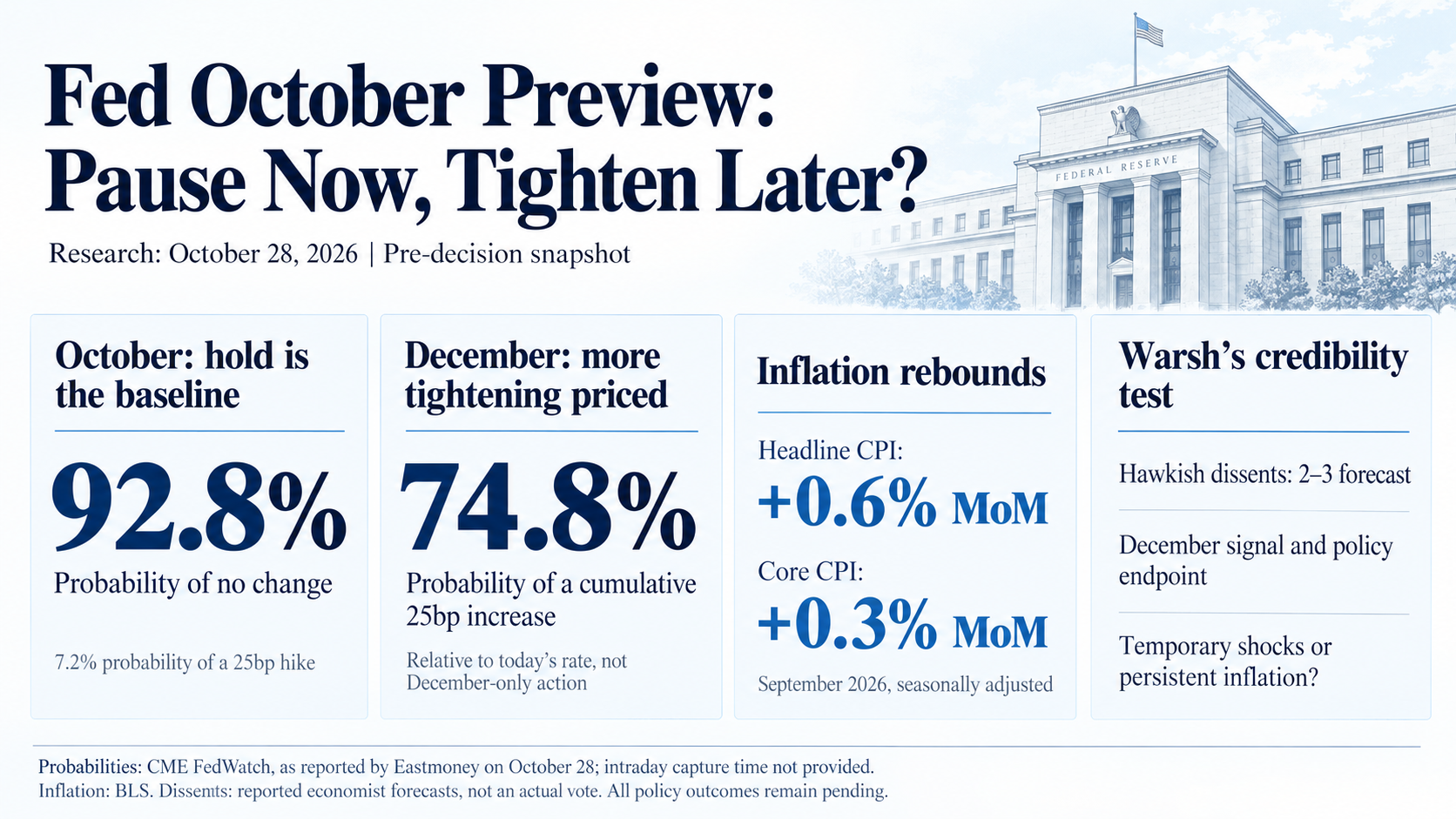
For the October 27–28 meeting, Eastmoney’s October 28 report puts the CME-implied odds overwhelmingly on no change. That makes an unchanged rate decision a weak standalone catalyst. Its significance depends on whether officials describe it as time to assess transmission or as evidence that further increases may be unnecessary.
October 28: a hold is heavily priced
View chart data
| Outcome | Probability (probability %) |
|---|---|
| No change | 92.8 |
| +25bp hike | 7.2 |
December pricing points in a different direction. The same report assigns the largest probability to a target range one quarter-point above today’s level by the December 8–9 meeting. This captures the market’s expectation of further tightening before year-end. It does not isolate the probability of an increase at the December meeting itself: an earlier move could also produce that endpoint.
By December 9: another quarter-point is the leading reported outcome
View chart data
| Outcome | Probability (probability %) |
|---|---|
| No cumulative change | 19.5 |
| +25bp cumulative | 74.8 |
The practical distinction matters. A hold followed by hawkish December language can preserve the prevailing path; a hold paired with a convincing argument that rates are already restrictive enough could challenge it. Conversely, an unexpected October increase would bring tightening forward and force investors to reconsider the pace as well as the eventual peak.
These are dated probabilities reported by Eastmoney, not a live numerical download from CME. The article did not give an intraday capture time or identify all December buckets. The supplied PDF uses a separate October 27 OIS-based table, with roughly 10% October and 75% December hike-equivalent pricing. That table is not CME FedWatch and is not combined with the figures above. Market pricing can change before the announcement.
Warsh Faces Hotter Inflation, Hawkish Dissents and a December Decision
The inflation backdrop makes a pause harder to explain. September headline CPI rose 3.7% from a year earlier, up from 3.4% in August; core rose 2.6%, up from 2.4%. Core’s 0.3% monthly gain also exceeded the 0.2% consensus cited by WallstreetCN. Energy increased 5.2% on the month. The monthly comparison below shows why officials must decide whether the rebound will fade or become more persistent. BLS September release.
Inflation momentum: headline accelerates, core stays firm
View chart data
| Month / series | Change (MoM %) |
|---|---|
| Jul · Headline | 0.1 |
| Jul · Core | 0.2 |
| Aug · Headline | 0.4 |
| Aug · Core | 0.3 |
| Sep · Headline | 0.6 |
| Sep · Core | 0.3 |
Rate increases cannot directly restore energy supply. They can restrain demand and limit the ability of higher input costs to spread into sustained price increases. The decision therefore turns on persistence: temporary energy effects would support patience, while broader pricing pressure would strengthen the argument for tightening. The Fed’s inflation objective uses PCE, so CPI readings should inform that assessment without being treated as the target measure itself.
The vote may reveal more than the unchanged rate. JPMorgan’s Michael Feroli expects at least two hawkish dissents, from Beth Hammack and Lorie Logan, with Neel Kashkari a possible third; Rabobank and Natixis anticipate three, according to WallstreetCN’s October 28 report. These are forecasts. A projected 9–3 split must not be mistaken for an announced vote. A hold with several calls for immediate action would signal disagreement over urgency even if the majority still favors waiting.
Warsh’s harder task is to explain the committee’s conditions for its next decision. His resistance to forward guidance does not remove investors’ need to understand what would make December action appropriate. Clarifying which evidence matters can reduce uncertainty without promising a specific vote. Silence about the endpoint would leave investors relying more heavily on competing regional-bank messages.
What to listen for at the press conference
- December: Does Warsh keep another increase clearly available, and what evidence would justify it?
- Restriction: Does he describe current policy as sufficiently restrictive, or still needing adjustment?
- Persistence: Is inflation mainly a temporary shock, or is demand sustaining it?
- Financial conditions: How much weight does he place on higher long-term borrowing costs?
Higher long-term yields offer a reason to wait because mortgages, corporate financing and valuations can tighten before another policy-rate increase. Sina’s October 28 report highlights Vice Chair Philip Jefferson’s argument for allowing more time to assess those effects. But a high bond yield is ambiguous: it can reflect restraint on demand, rising inflation compensation, or concern about fiscal risk. Its level alone cannot establish that inflation is being contained.
Our reading is that a sustained tightening cycle would become more plausible if inflation remains broad while spending and employment absorb higher borrowing costs. A final December increase becomes more plausible if energy pressure fades, core momentum cools and existing restraint becomes visible in activity. This is a framework for interpreting new evidence, not a probability forecast. A change in risk-asset prices would matter more if it spread into credit availability and the real economy.
Communication can also move the yield curve through different channels. Emphasis on further policy restraint could lift expectations for short rates. A poorly explained pause could instead leave longer-term inflation concerns unresolved. The useful test is which part of the expected rate path changes, rather than whether the decision receives a simple hawkish or dovish label.
The statement is scheduled for October 28 at 2:00 p.m. EDT, followed by the press conference at 2:30 p.m.; these correspond to October 29 at 2:00 a.m. and 2:30 a.m. Beijing time. The official calendar places the meeting on October 27–28. Some commentators connect the expected pause with the approaching midterm elections. That is an interpretation of political incentives, not an established explanation from the committee.
Economists Split on an October Surprise and the End of Tightening
The most useful disagreement concerns the assumptions behind the forecasts. Some economists see inflation requiring faster action; others see a temporary shock that will fade, or borrowing costs already doing enough damage. Those views can produce different conclusions about both the next meeting and the eventual peak in rates.
Bank of America challenges the timing consensus. Aditya Bhave and the bank’s team retain an October-hike forecast in October 27–28 reporting. ANZ’s Brian Martin also argues that markets underprice action. Their position raises the hurdle for a persuasive pause: officials would need to explain why the inflation evidence permits another interval of waiting.
Goldman Sachs challenges the longer tightening path. David Mericle’s team expects one more increase in December to finish the cycle. Its reported forecast puts core PCE near 2.2% by the end of 2027 as temporary pressures unwind. That is a forecast contingent on disinflation, rather than proof that current policy is sufficient.
| View | Central assumption | Evidence to watch |
|---|---|---|
| BofA / ANZ: act sooner | Inflation warrants faster restraint. | Persistent core pressure and strong demand. |
| Goldman: December ends the cycle | Temporary pressures fade. | Cooling underlying PCE inflation. |
| Apollo: demand matters | Supply normalization alone may be insufficient. | Demand-sensitive inflation and spending. |
| El-Erian: further hikes risk harm | Credit-sensitive activity bears excessive costs. | Housing, consumer credit and financing conditions. |
Apollo’s Torsten Slok questions reliance on supply normalization. WallstreetCN describes his reading of San Francisco Fed data as showing roughly equal demand and supply contributions to core PCE inflation. If demand is an important driver, waiting for energy and other disruptions to unwind may leave a meaningful source of pressure intact.
Mohamed El-Erian emphasizes the cost of additional restraint. As reported by Eastmoney, he argues that further hikes would hurt mortgages, auto loans and consumer credit, while fiscal discipline is needed to address the underlying problem. His argument focuses attention on where tightening bites, rather than treating technology-sector resilience as evidence that the wider economy can absorb more.
Together, these positions make the December signal and the 2027 endpoint separate questions. Investors can broadly expect another increase before year-end and still disagree sharply over whether it finishes the job. Warsh’s explanation of inflation persistence and policy transmission will help determine which of those disagreements becomes the next market catalyst.
Expert positions are drawn from the supplied October 27–28 reporting and PDF. They are reported views, not newly obtained interviews or access to complete proprietary research notes. Institutional baselines can change. The conditional economic interpretation in this article is editorial analysis and should not be attributed wholesale to any one economist.