
Cybercab Is Finally on the Road — But What Exactly Has Launched?
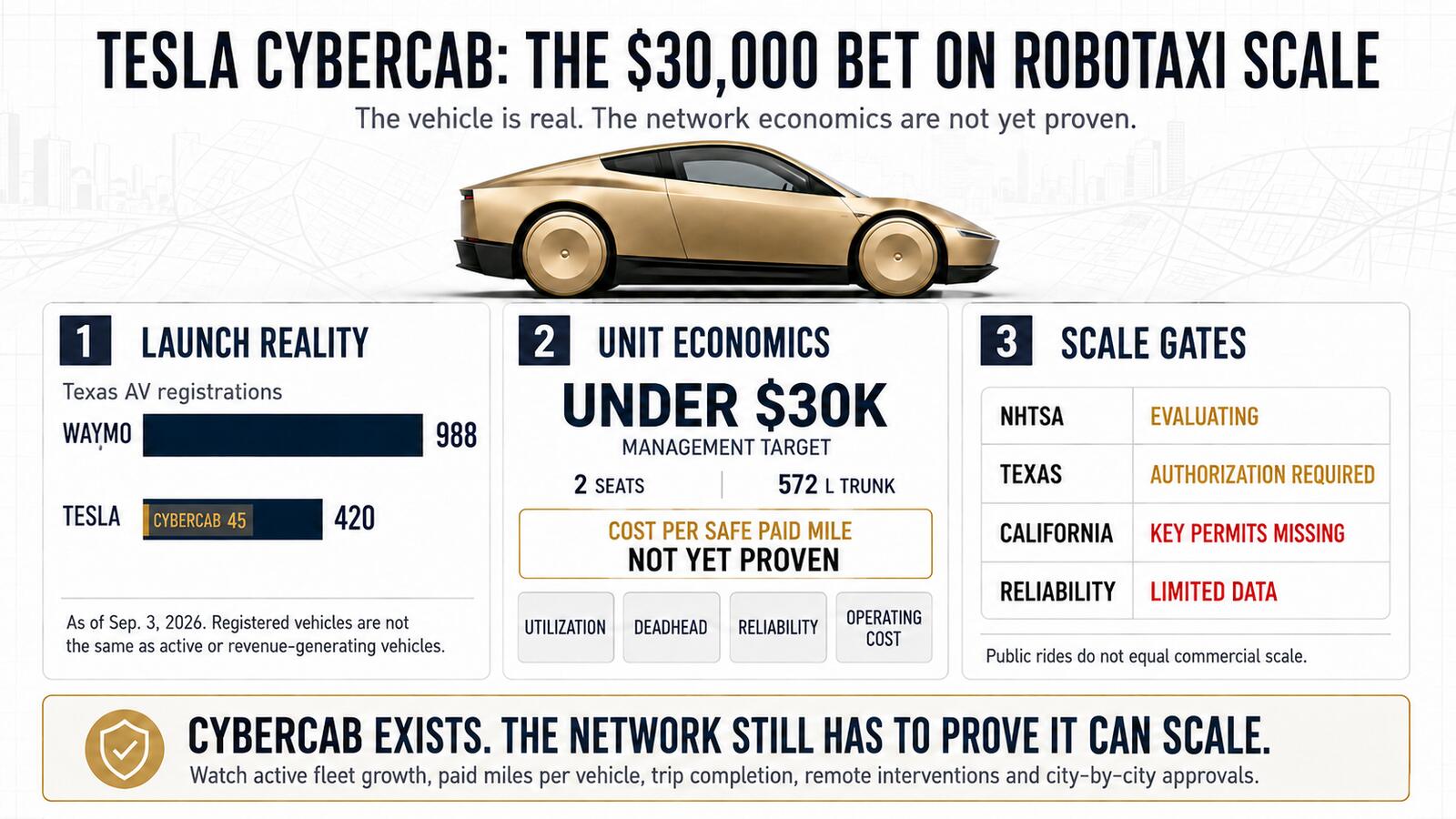
The September 3 Austin rollout changes the factual starting point: Cybercab is no longer only a concept display. Tesla has begun limited public rides in a defined area, using a two-seat vehicle with no steering wheel, accelerator pedal or brake pedal. Tesla’s Q2 2026 update also said production had begun, public-road engineering tests had started, and employee rides began at Giga Texas in July. The launch lowers product-existence, purpose-built integration and initial rider-interface risk; it does not establish a scaled commercial network.
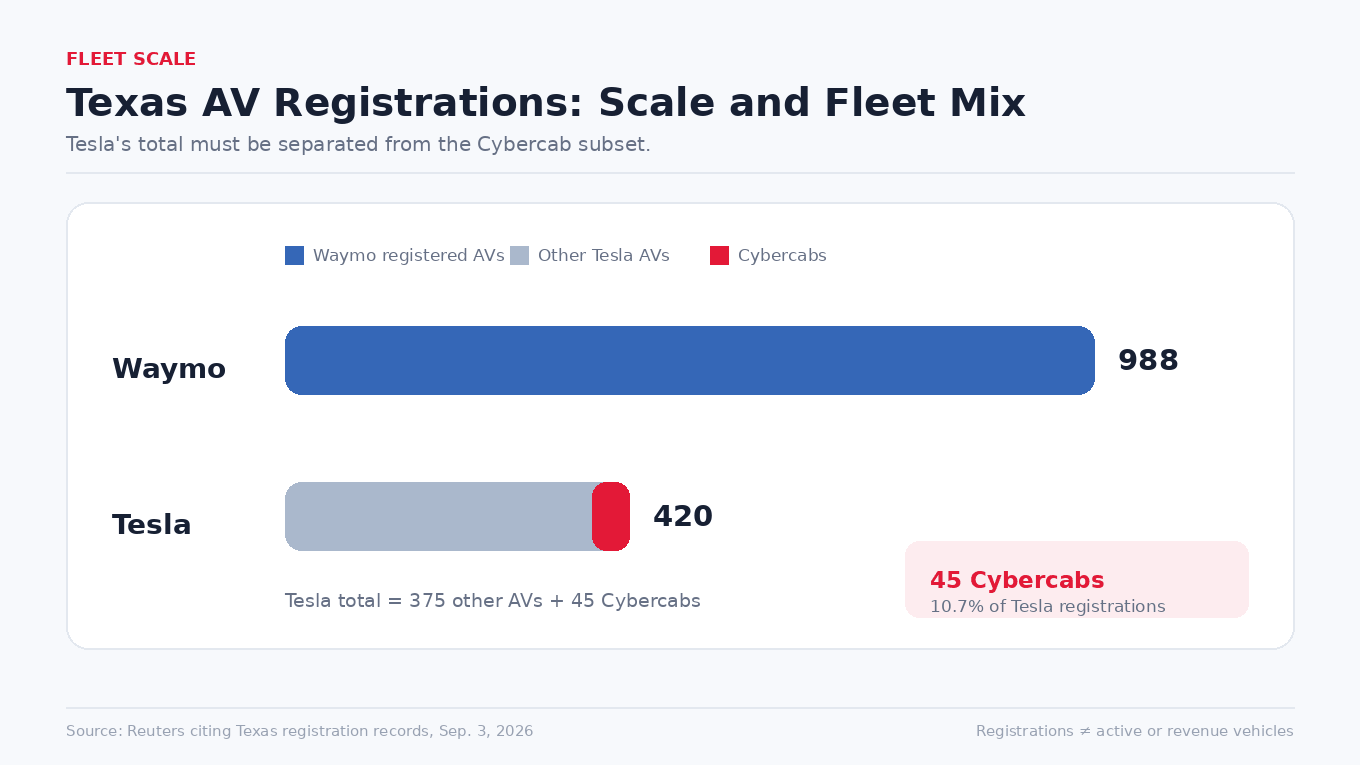
That registration snapshot is not a revenue count. Reuters reported 420 Tesla autonomous vehicles registered in Texas, including 45 Cybercabs, versus 988 Waymo vehicles. The remaining Tesla registrations are approximately 375 other vehicles. Registered vehicles are not the same as active, available or revenue-generating vehicles. Tesla’s FAQ says initial vehicles are assigned by availability and passenger count.
The market reaction — TSLA closed at $376.365 on September 3, up 5.42% — is evidence of sentiment, not proof of economics. The launch proves Cybercab can enter the network. It does not yet prove that the network can scale around Cybercab.
Cybercab Tutorial
Tesla Tutorials’ Cybercab tutorial provides product-level context for the vehicle’s design and use as Tesla develops its Robotaxi network. It appears above Unit Economics to separate product context from the still-unproven cost per safe paid mile.
The $30,000 Vehicle Is Not the Business Model — Cost per Safe Paid Mile Is
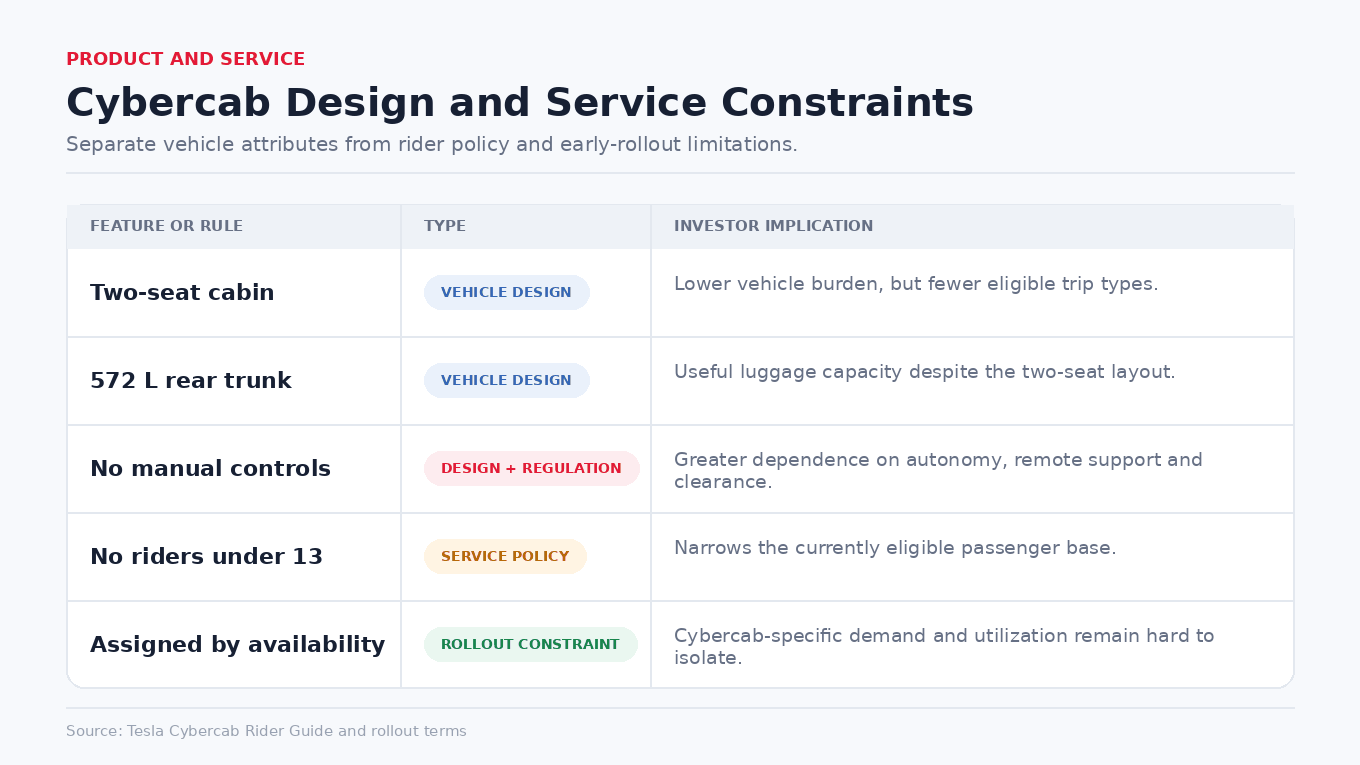
Cybercab’s economic promise rests on a target, not a transaction: Elon Musk has described an eventual price below $30,000. Tesla confirms a two-seat cabin, a 20.2-cubic-foot (572-liter) trunk, no frunk and no glove box, plus cabin support and emergency controls. Compact dimensions could reduce material, energy and cleaning burdens, while the two-seat layout narrows the addressable trip mix. The hardware advantage matters only if it survives the full operating cycle.
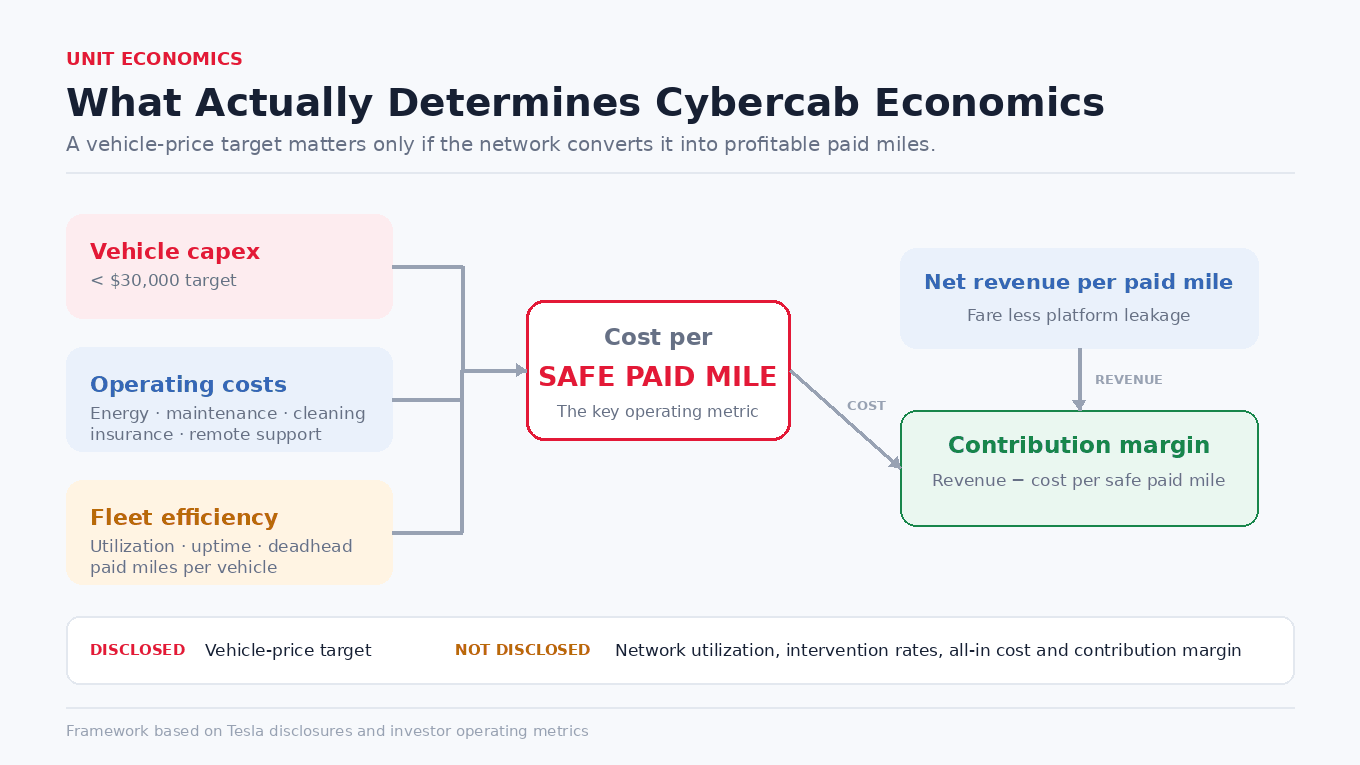
The investor metric is cost per safe paid mile. That requires paid miles per vehicle per day, utilization, deadhead ratio, completion rate, remote intervention frequency, charging, cleaning, maintenance, insurance, depreciation, downtime and platform take rate. None of those network-level metrics is disclosed here. A sub-$30,000 vehicle could matter, but only if it produces a lower cost per safe paid mile at high utilization.
| Product constraint | Why it matters |
|---|---|
| Two seats | May reduce vehicle burden but limits passenger mix. |
| 572 L trunk | Supports airport and luggage trips. |
| Under-13 riders prohibited | Narrows eligible demand and operating rules. |
| Availability assignment | Early riders cannot assume vehicle choice. |
Regulation and Reliability Will Set the Speed Limit
NHTSA is in contact with Tesla and evaluating the Cybercab rollout. That is neither a violation finding nor blanket approval. NHTSA’s 2022 standards update accommodated vehicles without traditional driving controls, but one federal rule does not automatically authorize nationwide commercial operation. Texas now requires commercial autonomous-vehicle operators to hold valid TxDMV authorization and address federal compliance, recording equipment, minimal-risk conditions, registration, insurance and first-responder interaction.
The operating constraint is economic as much as legal. A small geofence caps demand density and utilization; frequent remote intervention preserves labor cost; incidents, recalls or pauses raise insurance and downtime; and city-by-city approvals determine whether fixed assets can earn enough paid miles. Reuters’ Dallas test reported long waits, unavailable vehicles and a delivery that did not reach the marked service area. That is a media sample, not a network-wide failure rate. Tesla’s terms acknowledge that trips may be modified, canceled or fail to reach the requested destination.
Waymo has a larger Texas registration count and offers Austin rides through Uber, while Tesla’s potential advantages are manufacturing scale, cost control and vertical software integration. The public record does not provide a uniform basis to rank either company on unit cost or safety. The next proof points are active-fleet growth, paid miles per vehicle, ride completion, interventions, incident data, authorizations and fleet contribution economics.
Investor metric shift: Cybercab has left the stage. Tesla now has to prove the economics, reliability and regulatory repeatability of the network around it.
Risk Disclosure
For information only — not investment advice. Stock investments carry risk, including loss of principal. Data current through September 4, 2026; re-verify before acting.